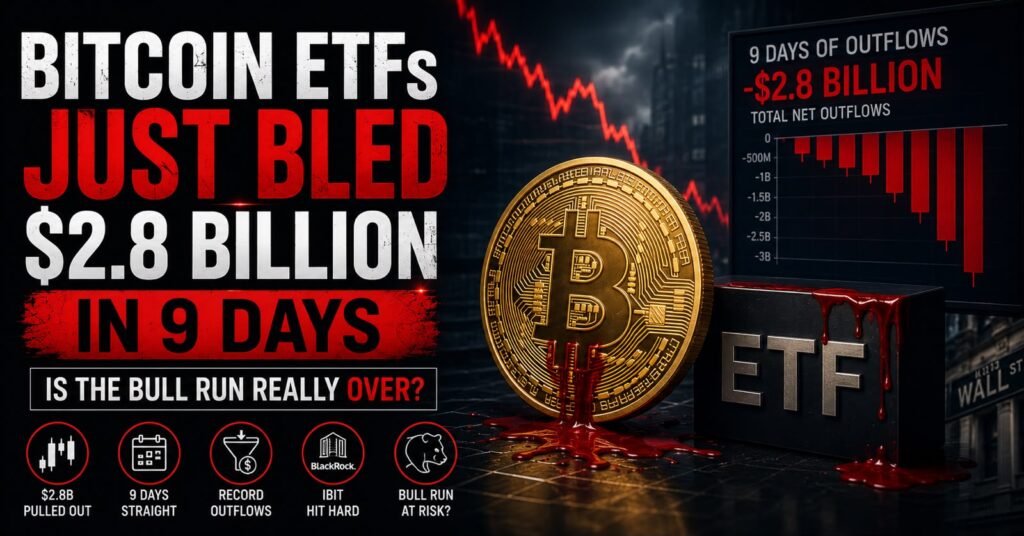
I want to start with something uncomfortable.
I have been in crypto long enough to remember when every conversation ended with someone saying “this is going to change everything.” The technology. The freedom. The financial revolution. People said it with the kind of certainty that made you feel like you were missing out on the most important moment in human history if you were not fully committed.
That energy has quieted down considerably.
The explosive retail enthusiasm of 2021 is gone. The NFT frenzy is a distant memory. The number of people posting their crypto gains on social media has dropped dramatically. Several high-profile projects collapsed. Entire ecosystems that were worth billions became worth almost nothing. Real people lost real money.
So the question being asked more honestly in 2026 than it ever was during the hype cycles is this: is crypto actually still worth paying attention to?
I have spent serious time thinking about this. Not from a price prediction angle — I am not going to tell you Bitcoin is going to $500,000 or that some altcoin is going to make you rich. But from the angle of someone who has been watching this space closely and trying to separate what is real from what was always noise.
Here is what I actually think.
What the Hype Cycle Actually Was
To answer whether crypto is worth it in 2026, it helps to understand what happened during the hype years — and what was real versus what was manufactured excitement.
The 2020-2021 bull market was driven by a combination of genuine innovation and extraordinary external conditions. Central banks around the world pumped trillions of dollars into economies to manage the pandemic. Interest rates were near zero. Traditional savings accounts were earning essentially nothing. People were stuck at home with stimulus checks and time to explore alternatives.
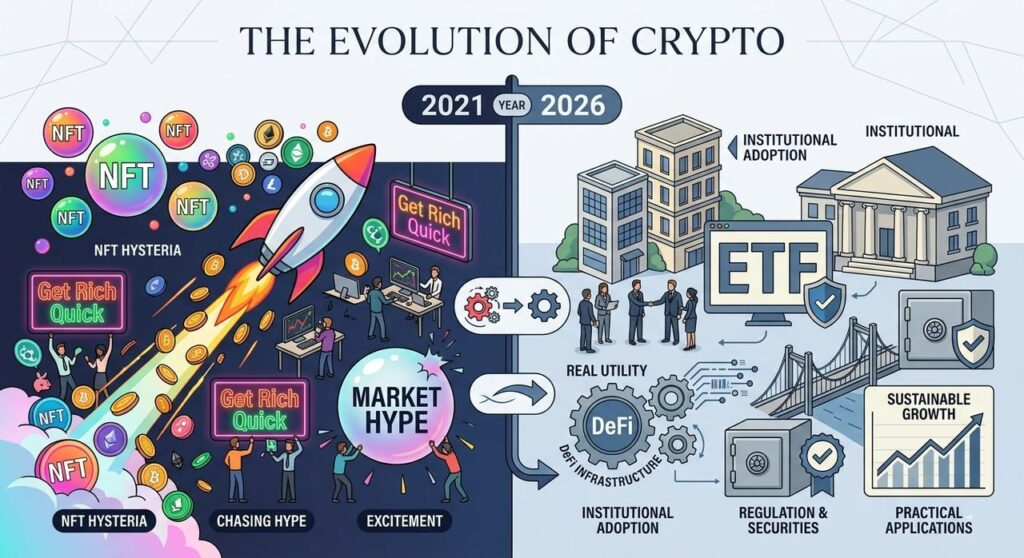
Crypto was the most exciting alternative available. And some of the excitement was justified — real things were being built. DeFi genuinely created financial services that operated without banks. NFTs, whatever their problems, demonstrated that digital ownership was possible. Layer 2 solutions were making Ethereum actually usable at scale.
But a significant portion of what got priced in during that period was speculation layered on top of speculation. Projects with no working product, no real users, and no clear path to creating value raised hundreds of millions of dollars. Tokens with nothing behind them reached valuations that made no rational sense. The money was everywhere and it chased everything indiscriminately.
When interest rates rose and the easy money dried up, the indiscriminate speculation collapsed. Most of it deserved to collapse. The projects that had no substance lost their value because they never had real value to begin with.
What survived the collapse is more interesting than what collapsed.
What Actually Survived — And Why It Matters
Bitcoin is still here. Not just surviving — it reached a new all time high above $100,000, something that seemed like fantasy to many people even three years ago. The institutional infrastructure that was built during and after the ETF approval process in early 2024 created a foundation that did not exist during previous cycles.
BlackRock, Fidelity and other major financial institutions now offer Bitcoin products to their clients. Pension funds in several countries have gained regulatory permission to allocate small percentages to Bitcoin. This is not hype — it is infrastructure. Infrastructure does not disappear when sentiment turns negative.
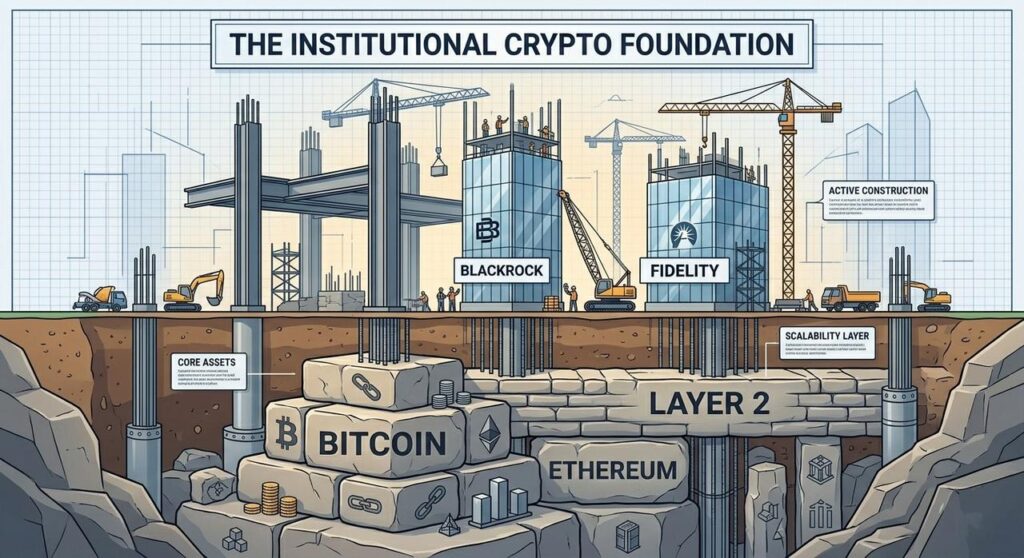
Ethereum is still here. Despite years of predictions that it would be overtaken by faster, cheaper competitors, Ethereum’s network continues to process the majority of serious DeFi activity. The developer ecosystem around Ethereum — the tools, the talent, the institutional familiarity — has proven more durable than most critics expected.
DeFi is still here. Smaller, more careful, more focused on genuine use cases than it was in 2021. But the core concept — financial services that operate through code rather than through institutions that can freeze your account, deny your transaction, or collapse overnight — did not disappear. The protocols that survived the 2022-2023 collapse did so because they were built more carefully and served real needs.
The infrastructure layer is stronger than it has ever been. Layer 2 networks like Arbitrum, Optimism, and Base are processing transactions at speeds and costs that make crypto applications genuinely competitive with traditional web applications for the first time. This matters enormously for actual adoption.
What Changed — And Why 2026 Feels Different
The shift that has happened between the hype peak and now is not just a price correction. It is a maturation.
The people who are in crypto in 2026 are largely there for different reasons than the people who were in crypto in 2021. The get-rich-quick crowd has mostly left. What remains is a combination of long-term believers, institutional capital, serious builders, and people who genuinely use these systems for specific purposes.
That is actually a healthier foundation than what existed before.
In 2021, crypto’s user base was primarily speculators. In 2026, it includes people using stablecoins for remittances in countries with unstable currencies, developers building applications that genuinely could not exist on traditional infrastructure, institutions managing exposure to a new asset class, and individuals who have lost trust in traditional financial systems for very concrete reasons.
The use cases that survived the hype collapse are the ones that solve real problems. Sending money across borders cheaply and quickly. Owning digital assets without relying on a platform that can revoke access. Accessing financial services in countries where banking infrastructure is inadequate. Creating financial instruments that operate transparently according to rules written in code that anyone can verify.
These use cases do not require you to believe crypto is going to replace all money. They just require you to believe that for specific problems, in specific contexts, blockchain-based solutions are genuinely better than the alternatives.
The Honest Case Against Crypto in 2026
I want to give this a fair hearing because I think most crypto content is too one-sided.
Volatility remains extreme. Bitcoin dropped over 30% multiple times in the past two years even within an overall upward trend. For most people, assets that can lose a third of their value in weeks are not suitable for any meaningful portion of their savings. The risk profile has not fundamentally changed even as the asset class has matured.
Regulation is still uncertain in many jurisdictions. The US has made significant progress but the global picture is complicated. Projects can still be shut down, exchanges can still face legal action, and the rules governing what you can do with crypto assets vary enormously depending on where you live.
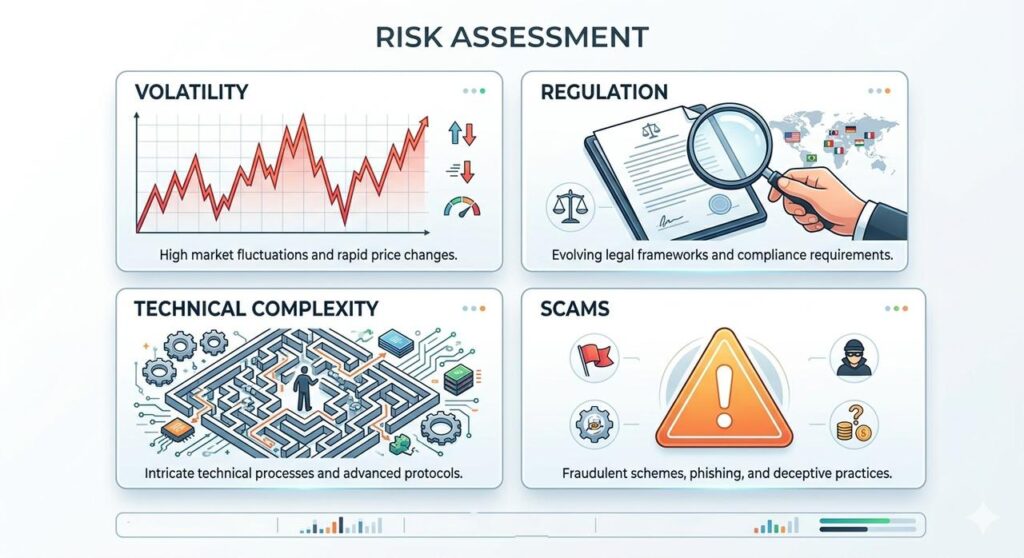
The complexity has not meaningfully decreased. Using crypto well still requires understanding concepts that most people find genuinely confusing. Seed phrases, private keys, gas fees, network selection, smart contract risks — these are real barriers that the industry has not solved despite years of trying.
Scams have not gone away. The ecosystem continues to attract bad actors who take advantage of people’s hope and greed. The number of people who have lost money to rug pulls, phishing attacks, and outright fraud is significant and the tools to protect against this require knowledge and vigilance that many users do not have.
These are real problems. Anyone who dismisses them is not being honest about the full picture.
So Is It Worth It — My Actual Answer
My honest answer in 2026 is: it depends entirely on what you mean by “worth it” and what you are actually trying to do.
If you are asking whether crypto is worth speculating in hoping to get rich quickly — the honest answer is probably not, for most people. The easy money phase is over. The people making serious money now are either long-term holders who have been through multiple cycles, institutions with sophisticated risk management, or builders creating genuine value. Random speculation in random tokens is a losing game for most participants.
If you are asking whether Bitcoin specifically is worth holding as part of a diversified long-term portfolio — the case is stronger than it has ever been. The institutional infrastructure, the ETF access, the track record of recovering from corrections, and the fixed supply all contribute to a reasonable long-term thesis. But only at a position size you could watch drop 50% without being forced to sell.
If you are asking whether the underlying technology is worth paying attention to — absolutely yes. The applications being built on blockchain infrastructure in 2026 are more interesting and more practically useful than anything that existed in 2021. The builders who stayed through the bear market are building things that actually work.
If you are asking whether crypto is dead — no. Not even close. But it is also not going to make everyone who touches it wealthy. It never was. The hype made it seem that way. Reality is more complicated and more interesting.
What I Am Actually Watching in 2026
Rather than price targets, here are the things I think actually matter as signals of whether crypto is developing real staying power.
Real world asset tokenization. If major financial institutions successfully bring bonds, real estate, and commodities on-chain at scale, it legitimizes blockchain infrastructure at a level that no amount of retail speculation ever could.
Payment adoption in emerging markets. The places where crypto makes the most immediate practical difference are countries with currency instability, high remittance costs, and limited banking access. Genuine adoption in these markets is a more meaningful signal than ETF flows.
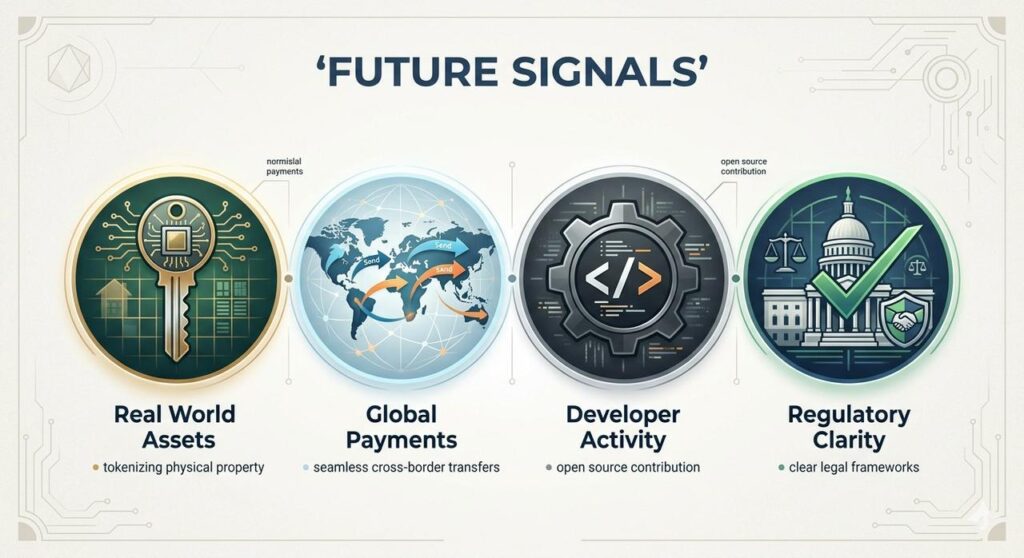
Regulatory clarity in major economies. The jurisdictions that figure out how to regulate crypto constructively rather than just defensively will attract talent and capital. The shape of that regulation matters enormously for the long-term trajectory.
Developer activity. The number of serious developers building on blockchain platforms is a leading indicator that matters more than current price. Development activity in 2026 is at all-time highs by most measures. That tends to precede adoption.
Final Thoughts
Crypto in 2026 is not the revolution its most enthusiastic supporters promised in 2021. But it is also not the fraud its most persistent critics insisted it was.
It is something more interesting and more complicated than either of those narratives — a technology and financial system that is finding its actual use cases, shedding the speculation that obscured them, and building infrastructure that will matter for years regardless of what prices do in the short term.
Whether it is worth your attention depends on what you are looking for. If you approach it honestly, with realistic expectations, appropriate risk management, and genuine curiosity about what is actually being built — yes, it is worth paying attention to.
If you are looking for a shortcut to wealth that does not require work, patience, or tolerance for risk — nothing is worth it. Crypto included.
You Might Also Like:-
How I Started Earning on Binance Square – Complete Guide
How to Launch Your Own Meme Coin on Pump.fun
This article is for educational and informational purposes only. Nothing here constitutes financial or investment advice. Cryptocurrency investments carry significant risk of loss. Always conduct your own research and consult a qualified financial advisor before making any investment decisions.

and content creator with over 5 years of
hands-on experience in blockchain technology
and digital assets. He actively trades and
researches crypto markets daily, and shares
insights with over 110,000 followers on
Binance Square. He founded CrypBuzz.com to
provide honest, research-backed crypto
education for everyday investors.