I have been watching crypto regulation news for years. Most of it is noise — committees discussing things, politicians making speeches, nothing actually changing.
But what happened on May 14, 2026 felt different.
The US Senate Banking Committee voted 15-9 to advance the Digital Asset Market Clarity Act — commonly called the Clarity Act — moving it closer to becoming actual law than any crypto regulation bill has ever been in American history.
If you are in crypto and you have not been paying attention to this, you should be. This is not another regulatory threat. This is potentially the most positive regulatory development crypto has seen since Bitcoin ETFs were approved in January 2024.
Here is everything you need to know — what the bill actually does, where it stands right now, and what it could mean for the market if it passes.
What the Clarity Act Actually Is
Before getting into the market implications, it helps to understand what this bill actually does — because most coverage either oversimplifies it or buries it in legal language.
The Digital Asset Market Clarity Act is a piece of legislation designed to answer a question that has been paralyzing the US crypto industry for years: who regulates crypto?

Right now, the situation is genuinely chaotic. The Securities and Exchange Commission (SEC) claims authority over most crypto tokens, calling them securities. The Commodity Futures Trading Commission (CFTC) claims authority over Bitcoin and Ethereum as commodities. These two agencies have been fighting each other for jurisdiction for years, while simultaneously taking enforcement actions against crypto companies that were not entirely sure which rules applied to them.
The Clarity Act draws clear lines. Under the bill, the CFTC gets exclusive jurisdiction over digital commodity spot markets — essentially Bitcoin, Ethereum, and most established cryptocurrencies. The SEC retains jurisdiction over investment contract assets — newer tokens that were sold with an expectation of profit from others’ efforts.
The bill also establishes formal registration processes for crypto exchanges, brokers, and dealers. It creates consumer protections, bankruptcy safeguards, and rules around insider trading in digital assets. It even includes provisions protecting DeFi developers from being treated as financial intermediaries simply for writing open-source code.
The latest version of the Clarity Act maintained legal protections for decentralized finance developers, keeping that corner of the crypto sector satisfied.
For the first time, crypto businesses operating in the US would know exactly what rules they are following, which regulator they answer to, and what they need to do to operate legally. That clarity — the word is literally in the bill’s name — is what the entire industry has been asking for.
What Just Happened — The Senate Banking Committee Vote
On May 14, the Senate Banking Committee voted 15-9 to advance the Clarity Act, with Democratic Senators Ruben Gallego of Arizona and Angela Alsobrooks of Maryland joining all Republicans on the panel to vote for the bill.
This is significant for a few reasons.
First, any Senate vote that gets bipartisan support — even just two Democrats crossing party lines — signals that the bill has broader appeal than pure partisan politics. That matters enormously for what comes next.
Second, the committee vote resolves a conflict that nearly killed the bill earlier this year. The Clarity Act nearly reached a Senate Banking markup earlier this year before Coinbase pulled its support from the bill over a proposed ban on stablecoin rewards. That issue has since been resolved through a compromise between Senators Thom Tillis and Angela Alsobrooks, which restricts passive deposit-like yield on payment stablecoins while allowing transaction-based rewards under tighter oversight.
Third, the vote gives the bill real momentum at a critical time. The markup gives Senate Banking another shot at moving the bill before the White House’s July 4 target for Clarity Act passage. There is now a real, stated deadline with political pressure behind it.
The market noticed immediately. Altcoins rallied on the Clarity Act advancement, with Hyperliquid rising around 11% and XDC and Canton gaining nearly 10%, reflecting the market’s renewed interest in institutional blockchain rails, trade finance, tokenization, and regulated on-chain finance.
What Still Has to Happen Before It Becomes Law
Here is where I want to be honest with you, because the path from committee vote to signed law is still genuinely uncertain.
The bill has not become law. It must still pass the full Senate, align with the House version, and receive the president’s signature.
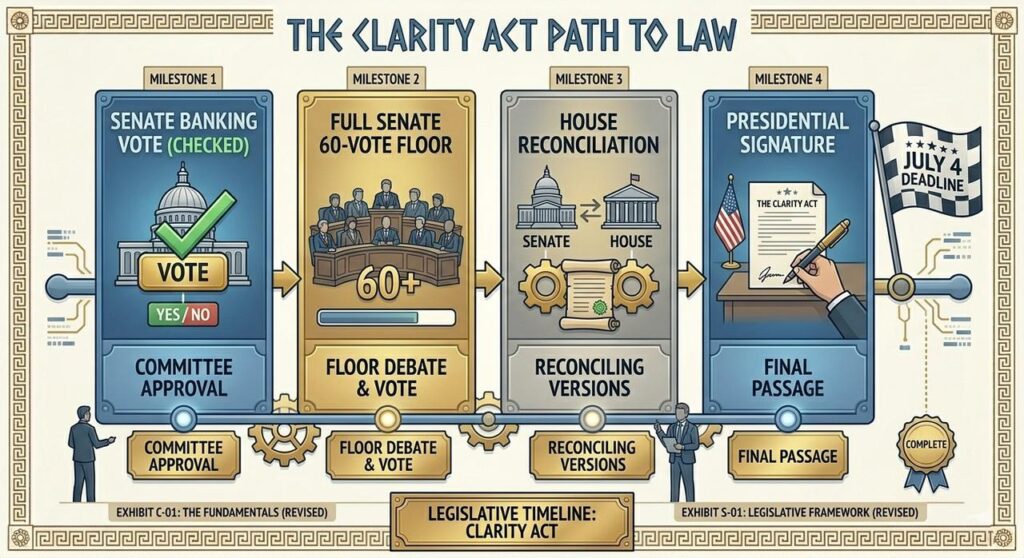
The full Senate vote requires 60 yes votes — the standard threshold for major legislation. That means the bill needs support from a significant number of Democrats beyond the two who voted for it in committee. So far, the progress through the Senate has been dependent on Republican party-line voting, but other crypto efforts have typically reached major bipartisan support when the final votes come around. Last year, the GENIUS Act succeeded on a 68-30 vote in the Senate, easily clearing the minimum.
The biggest remaining obstacle is the conflict-of-interest provision. Democrats won’t allow the bill to move without a conflict-of-interest section, Senator Kirsten Gillibrand said last week at Consensus Miami 2026. This provision would limit government officials — including, by implication, President Trump and his family — from profiting from the crypto industry while in office. The Trump administration has repeatedly said it would not accept a bill that singles out the president specifically.
This tension is real and unresolved. It could delay the bill significantly or force further negotiations.
After the Senate passes its version, the Banking Committee’s draft must be reconciled with the Agriculture Committee’s parallel version, and then aligned with the House version before going to the president’s desk.
This is not a simple process. But it is further along than crypto regulation has ever been in the United States.
What This Means for Crypto Prices — Honest Analysis
Let me be direct about something: nobody can tell you with certainty what the Clarity Act passing will do to crypto prices. Anyone who gives you a specific price target tied to this bill is speculating.
What I can do is walk through the logical chain of effects and let you evaluate the reasoning yourself.
Institutional capital has been waiting for this. The single biggest barrier keeping large institutional money out of crypto — beyond Bitcoin ETFs — has been regulatory uncertainty. Fund managers, pension funds, and corporate treasuries cannot allocate to an asset class where the regulatory framework could change dramatically at any moment. The Clarity Act removes that uncertainty. When institutions can model a stable regulatory environment, they can build investment theses. That capital eventually moves into the market.
Exchange listings accelerate. With clear rules about which assets are commodities and which are securities, exchanges can list more tokens with confidence. More listings mean more liquidity, more accessibility, and more capital flowing into the broader market beyond just Bitcoin and Ethereum.
US-based builders return. A significant number of crypto projects and companies relocated outside the US specifically to avoid regulatory uncertainty. Regulatory clarity changes the calculus. Talent and capital that left could return, strengthening the ecosystem.
DeFi specifically benefits. The legal protections for DeFi developers included in the Clarity Act are something the DeFi sector has been asking for explicitly. Removing the legal risk of building open-source financial protocols in the US could unlock a wave of development activity.
The psychological effect is real. Markets price in expectations before events happen. The committee vote itself caused immediate price appreciation. Full Senate passage would likely cause a more significant response. Presidential signing would be another catalyst. Each step forward is a separately tradeable event.
The Risks — What Could Go Wrong
I want to give this a fair hearing because optimism without risk assessment is not useful analysis.
The ethics provision conflict is real and could delay or kill the bill. If Democrats hold firm on requiring conflict-of-interest language and the Trump administration refuses any version that applies to the president, the bill could stall indefinitely.
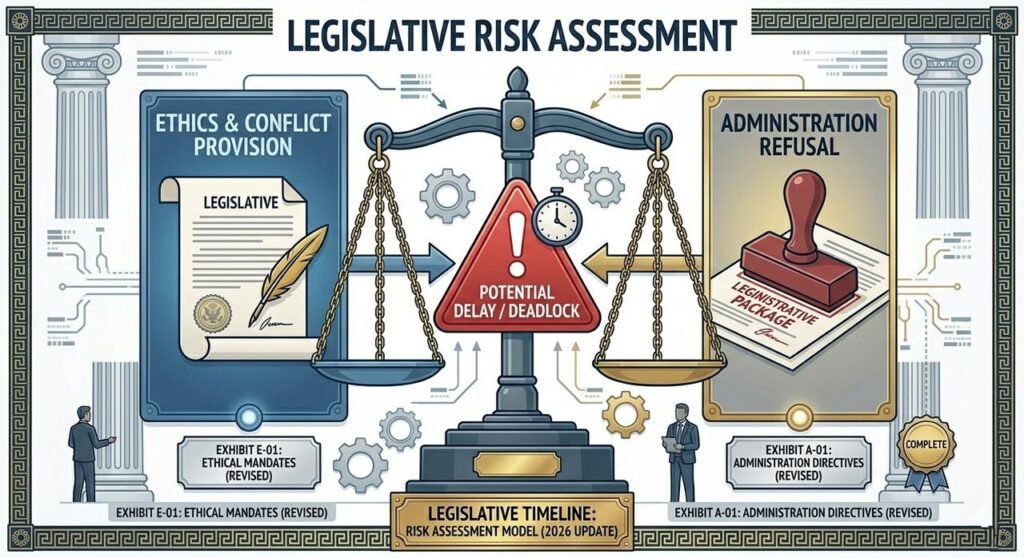
Congressional timing is always uncertain. As time ticks down toward summer recess and the midterm elections, the Clarity Act still has an uncomfortably thin margin for error. Summer recess could push everything to after midterms, where the political dynamics might look very different.
Even passed legislation takes time to implement. The CFTC and SEC would need months to develop the actual rules and processes the bill mandates. The immediate practical effect on the market would be gradual, not overnight.
And markets may have already priced in significant optimism. If the bill passes but the reality disappoints expectations that had already run high, prices could correct even on positive news — a classic “buy the rumor, sell the news” scenario.
What Pakistan and Emerging Market Crypto Holders Should Know
This is something most international crypto coverage skips entirely, but it matters for people in markets like Pakistan, India, and across the Middle East and Southeast Asia.
When the US establishes clear regulatory frameworks for crypto, it has a ripple effect globally. Other regulators watch what the world’s largest financial market does and calibrate their own approaches accordingly. Pakistan’s own crypto regulatory developments — including the formation of the Pakistan Crypto Council — are happening in an environment where US direction matters.
For holders of Bitcoin and major altcoins in these markets, a clearer US regulatory environment means more institutional demand globally, which tends to support prices across the board. It also means more legitimacy for crypto as an asset class in conversations with local regulators and banks.
The Clarity Act is an American bill. But its effects, if it passes, will be felt across every market where crypto is traded.
Where Things Stand Right Now — May 2026
To summarize the current situation clearly:
The Clarity Act passed the Senate Banking Committee on May 14 with bipartisan support. It now needs to be merged with the Senate Agriculture Committee’s version, then pass the full Senate with 60 votes, then align with the House version that passed last year, then be signed by President Trump.
The White House has a stated target of July 4 for passage. Whether that deadline is realistic given the remaining obstacles — particularly the ethics provision — is genuinely uncertain.
What is certain is that this bill is closer to becoming law than any comprehensive crypto regulation has ever been in the United States. And that matters for every person holding crypto anywhere in the world.
Final Thoughts
I am not going to tell you to buy or sell anything based on this bill. That is not what this article is for, and anyone who frames regulatory news as a trading signal is doing you a disservice.
What I will say is this: the Clarity Act represents something the crypto market has needed for years — a serious, substantive attempt by the US government to create rules that allow the industry to operate with predictability. Whether this specific bill passes in its current form or gets modified further, the direction of travel is clear.
The regulatory war in the US is shifting from “should crypto exist” to “how should it be regulated.” That is a fundamentally different and more positive environment for every participant in this market.
Pay attention to what happens next. This is one of the most important stories in crypto in 2026 — and it is moving fast.
This article is for educational and informational purposes only. Nothing here constitutes financial or investment advice. Cryptocurrency markets carry significant risk. Always conduct your own research before making any investment decisions.
You might like these:-
How I Finally Understood Crypto Charts — A Beginner’s Honest Guide to Candlesticks
Is Crypto Still Worth It in 2026 — An Honest Look After All The Hype

and content creator with over 5 years of
hands-on experience in blockchain technology
and digital assets. He actively trades and
researches crypto markets daily, and shares
insights with over 110,000 followers on
Binance Square. He founded CrypBuzz.com to
provide honest, research-backed crypto
education for everyday investors.