I have been in crypto long enough to know that when Elon Musk’s name appears next to a Bitcoin number, the entire market pays attention.
But this one was different.
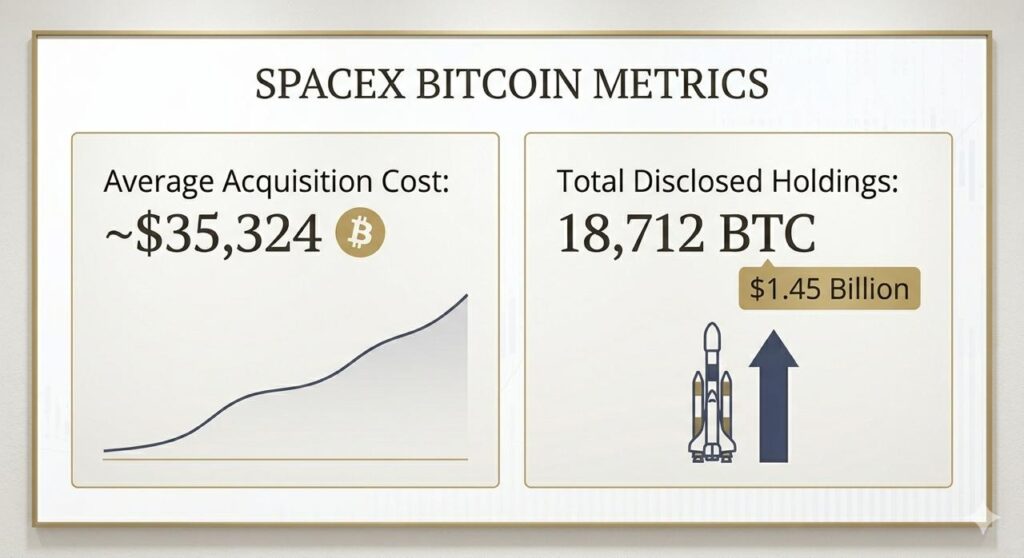
This was not a tweet. This was not a joke about Dogecoin. This was a formal SEC filing — a legal document submitted to the United States Securities and Exchange Commission — revealing that SpaceX, Elon Musk’s rocket company, has been quietly sitting on 18,712 Bitcoin worth approximately $1.45 billion.
And most people in the market had no idea.
I was going through my morning news on May 20, 2026 when the story broke. Within minutes, my Telegram groups were going crazy. Traders were scrambling to understand what it meant. Was this bullish? Was this already priced in? Should they be buying?
Let me break down exactly what happened, what the filing actually says, and why I think this matters more than most of the noise that comes out of crypto Twitter on any given day.
What Actually Happened — The SpaceX IPO Filing
SpaceX officially confirmed plans to go public on May 20, 2026, filing its S-1 registration statement with the Securities and Exchange Commission.
For those who do not follow traditional finance, an S-1 is the document a private company submits to the SEC when it wants to become publicly traded. It contains everything — revenue, losses, ownership structure, risks, and assets. It is essentially the first time the public gets to see the real financial picture of a company that has operated privately for years.
SpaceX plans to list on Nasdaq, and the filing reveals the company is seeking a valuation of more than $1.5 trillion, which would place it among the ten most valuable publicly traded firms globally.
That valuation number alone would make this one of the most significant IPOs in history.
But buried inside that filing — alongside rocket launch statistics and Starlink subscriber numbers — was something that immediately caught the attention of the entire crypto world.
SpaceX disclosed 18,712 BTC on hand as of March 31, 2026, recognized at a fair value of $1.29 billion. At current prices, this stash would be worth $1.45 billion. The total cost basis of these holdings was reported at $661 million, implying an average acquisition cost of around $35,324 per BTC.
Let that sink in for a moment. SpaceX bought nearly 19,000 Bitcoin at an average price of roughly $35,000 per coin. Today those coins are worth more than double what they paid for them.
The Part That Surprised Everyone — Nobody Knew How Much They Had
Here is what makes this story genuinely interesting beyond just the headline number.
For years, on-chain analysts had been trying to figure out how much Bitcoin SpaceX actually held. Blockchain data is public — every transaction is visible — but identifying which wallets belong to which company is an educated guess unless the company confirms it.
Earlier, Bitcoin tracking platform Bitcoin Treasuries had estimated that SpaceX had purchased over 25,000 BTC in the initial phase. Last year, blockchain researchers noticed wallet activity for almost $143 million in Bitcoin linked to Elon Musk’s SpaceX. At the time, many thought that the firm held approximately 8,285 BTC.
So the market was working with an estimate of roughly 8,000 Bitcoin. The actual number — confirmed by a legal SEC filing — is 18,712. More than twice what anyone thought.
SpaceX disclosed in their IPO paperwork that the company holds 18,712 Bitcoin worth $1.4 billion — more than two times as much Bitcoin as previously reported.
This matters because it changes the narrative around corporate Bitcoin adoption significantly. If even the estimates from professional on-chain analysts were this far off for one of the world’s most closely watched private companies — how many other large corporations might be holding Bitcoin positions that the market does not know about yet?
How SpaceX Compares to Other Corporate Bitcoin Holders
To understand the scale of SpaceX’s Bitcoin position, it helps to put it in context.
Per the disclosed figure of 18,712 BTC, SpaceX ranks approximately 11th globally among corporate Bitcoin holders. The position is larger than Tesla, which held 11,509 BTC as of its Q1 2026 disclosure after selling roughly 75% of its position in mid-2022. It is also larger than Coinbase corporate balance sheet holdings and Block Inc.
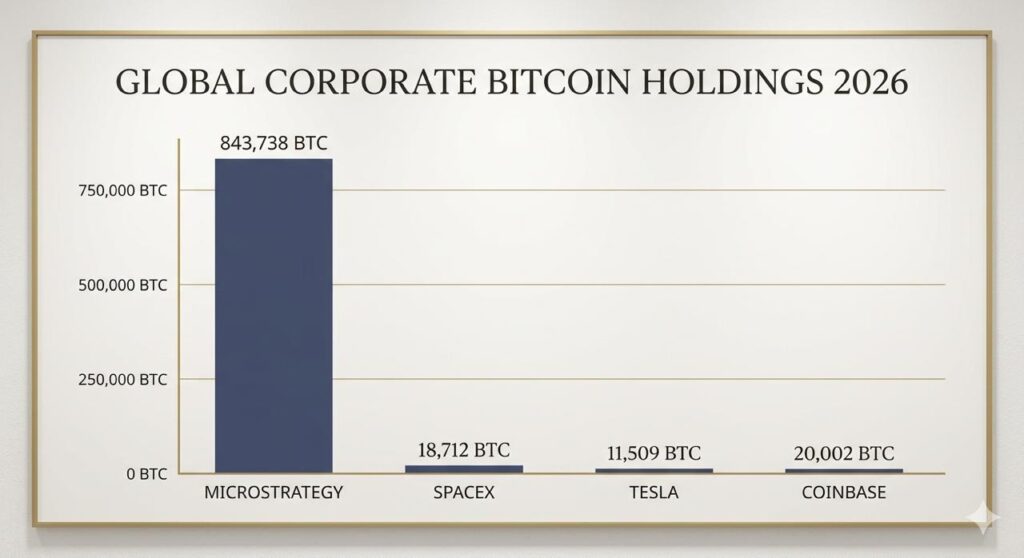
Yes — SpaceX holds more Bitcoin than Tesla. The same Elon Musk whose electric car company famously bought $1.5 billion in Bitcoin in early 2021 and then sold most of it a year later — his rocket company quietly held onto a larger position throughout.
It remains in stark contrast to MicroStrategy, which has acquired Bitcoin on a near-weekly cadence and now holds 843,738 BTC — roughly 45 times SpaceX’s position. This highlights how distinct the two companies’ Bitcoin strategies are. MicroStrategy has positioned Bitcoin accumulation as its core capital allocation thesis; SpaceX’s position appears to function differently.
The comparison with MicroStrategy is revealing. MicroStrategy treats Bitcoin as its primary business strategy. SpaceX treats it as a treasury asset — a portion of its cash reserves held in Bitcoin rather than dollars. These are fundamentally different approaches, and SpaceX’s approach is actually more representative of how most large companies that hold Bitcoin think about it.
What the Filing Says About How They Store It
One detail in the filing that most coverage glossed over is worth paying attention to.
The filing read: “The Company has ownership of and control over its digital assets, which consist of Bitcoin and utilizes, and expects to continue to utilize third-party custodians to hold its Bitcoin.
This is significant for a few reasons.
First, it confirms that SpaceX uses institutional-grade custody — not self-custody wallets, not exchange accounts, but regulated third party custodians. This is the same approach that BlackRock, Fidelity and other institutional players use. It signals that SpaceX treats its Bitcoin position with the same seriousness as any other significant financial asset.
Second, the use of third-party custodians explains why on-chain analysts had such difficulty tracking the actual holdings. Custodians pool assets and manage them in ways that are not always directly traceable to individual clients on the blockchain.
The IPO Numbers Beyond Bitcoin
While the Bitcoin story dominated crypto coverage, the SpaceX filing contains financial information that provides important context.
The filing showed SpaceX generated $4.69 billion in first-quarter revenue and recorded a $4.28 billion net loss. The company also disclosed that Elon Musk will remain CEO, CTO and chairman, retaining control through SpaceX’s dual-class shares.
SpaceX said it completed about 650 launches and handled over 80% of global orbital mass in 2025.
A $4.28 billion net loss in a single quarter sounds alarming at first glance. But for a company investing aggressively in Starlink expansion, Starship development, and multiple other programs simultaneously, heavy losses during expansion phases are not unusual. Amazon lost money for years before its infrastructure investments started generating returns at scale.
SpaceX is pursuing a plan to begin its IPO briefing schedule for large institutional investors on June 8.
The IPO itself — expected to be one of the largest in history — will be another significant moment for both traditional finance and crypto markets when it arrives.
Why This Matters for Crypto Investors
Let me be direct about why I think this story is genuinely significant rather than just a flashy headline.
It changes the corporate adoption narrative. Every time a major company is confirmed to hold Bitcoin, it expands the perception of Bitcoin as a legitimate treasury asset. SpaceX is not a crypto company. It is one of the most technologically sophisticated and capital-intensive companies on earth. Its Bitcoin holding — confirmed in a formal SEC filing — signals that Bitcoin has a place on the balance sheets of serious technology companies.
The surprise factor matters. Markets had priced in roughly 8,000 BTC for SpaceX. The actual number was more than double. This means the market’s estimate of corporate Bitcoin holdings across all companies may be significantly understated. If SpaceX was this far under-estimated, which other companies are holding more than anyone thinks?
It comes at a specific moment. This disclosure happened alongside the Clarity Act advancing in the Senate, Trump’s executive order directing crypto integration into traditional finance, and Bitcoin trading near all-time highs. Each of these developments reinforces the others. The regulatory environment is improving. Institutional adoption is confirmed and growing. The infrastructure for large-scale corporate and institutional Bitcoin exposure is being built.
The timing relative to the IPO matters. When SpaceX lists on Nasdaq — potentially as one of the most valuable companies ever to go public — its Bitcoin position becomes visible to every institutional investor who buys its stock. Fund managers who have never bought a single Bitcoin will indirectly hold Bitcoin exposure through SPCX shares. This creates a new category of indirect Bitcoin demand that did not exist before.
What I Am Watching Next
A few things will determine whether this story has lasting impact or fades quickly.
The SpaceX IPO price will tell us whether institutional investors view the Bitcoin holding as an asset or a risk. If the company prices at the high end of its expected range, it signals that institutions are comfortable with corporate Bitcoin exposure. If it prices lower than expected, it might indicate hesitation.
Other S-1 filings are worth watching. SpaceX’s disclosure will make it harder for other companies filing for IPOs to keep their Bitcoin holdings quiet. Expect more disclosures in the coming months as companies prepare for public listings.
Bitcoin’s price reaction over the next few weeks will indicate how much of this news was already priced in. A strong move higher would suggest the market is still processing the significance. A muted reaction would suggest it was already anticipated.
Final Thoughts

Elon Musk’s companies have a complicated relationship with Bitcoin. Tesla bought and sold. SpaceX bought and held quietly for years. The contrast between those two strategies is interesting on its own.
But the bigger story here is not about Elon Musk at all. It is about what happens when one of the most high-profile IPO filings of the decade casually includes a billion-dollar Bitcoin position in its balance sheet like it is the most normal thing in the world.
Because increasingly — it is.
Corporate Bitcoin is not a novelty anymore. It is a treasury strategy. It is an asset class. And it is sitting on the balance sheets of companies you would not expect, in amounts larger than anyone realized.
SpaceX just confirmed that. Quietly, in a legal document, the way serious money always moves.
This article is for educational and informational purposes only. Nothing here constitutes financial or investment advice. Cryptocurrency markets carry significant risk of loss. Always conduct your own research and consult a qualified financial advisor before making any investment decisions.
You might also like this:-
This development comes alongside the US Clarity Act advancing in the Senate — [read our full analysis here]
5 Mistakes New Crypto Investors Make (And How to Avoid Them)

and content creator with over 5 years of
hands-on experience in blockchain technology
and digital assets. He actively trades and
researches crypto markets daily, and shares
insights with over 110,000 followers on
Binance Square. He founded CrypBuzz.com to
provide honest, research-backed crypto
education for everyday investors.