The first time I heard the word “airdrop,” I genuinely thought someone was dropping cash from a helicopter. I’m not joking. A friend texted me saying he got free tokens from an airdrop and I spent five minutes trying to figure out what aviation had to do with crypto.
If you’re equally confused right now, don’t worry. By the end of this guide you’ll know exactly what airdrops are, how they work, which ones are worth your time, and most importantly — how to avoid the scams that come disguised as free money.
So What Actually Is a Crypto Airdrop?
A crypto airdrop is when a blockchain project sends free tokens or coins directly to wallet addresses — usually to promote themselves, reward early users, or build a community.

Think of it like a new restaurant opening in your area and giving out free food samples. They want people to try their product, talk about it, and hopefully become regular customers. Crypto projects do the same thing — except instead of samosas, they’re giving away digital tokens.
Some airdrops are worth almost nothing. Others have made people thousands of dollars overnight. The tricky part is knowing which is which before you waste your time.
Why Do Projects Do Airdrops?
This is the question most beginners skip — and it’s actually the most important one.
Projects airdrop tokens for a few reasons:
Marketing and awareness — Sending tokens to thousands of wallets gets people talking. If you receive something for free, you’re likely to at least Google what it is.
Rewarding early users — Many protocols airdrop tokens to people who used their platform before it launched a token. This is called a “retroactive airdrop.” Uniswap did this in 2020 and gave every past user 400 UNI tokens — which at peak prices were worth over $17,000.
Decentralizing ownership — Instead of keeping all tokens with investors and founders, projects distribute tokens widely so the community has a stake in the project’s future.
Building a user base — Free tokens attract attention. People claim them, hold them, and sometimes become actual users of the platform.
Types of Airdrops You’ll Come Across
Not all airdrops work the same way. Here are the main types:
Standard Airdrop — You simply register or sign up, provide your wallet address, and tokens get sent to you. Minimal effort required.
Holder Airdrop — You receive tokens just for holding a specific cryptocurrency in your wallet. For example, holding Bitcoin or Ethereum at a certain date might qualify you automatically.
Retroactive Airdrop — You already used a protocol before they launched their token, so they reward your early activity by sending tokens to your wallet. These are the most valuable type because they reward real users.
Task-Based Airdrop — You complete tasks like following a Twitter account, joining a Telegram group, or retweeting a post to qualify for tokens.
Exclusive Airdrop — Reserved for specific users — usually active community members, NFT holders, or early testers.
How to Find Legitimate Airdrops
This is where most beginners get stuck — or worse, get scammed. Here’s how I personally find real airdrops:
CoinMarketCap Airdrops — CoinMarketCap has a dedicated airdrop section that lists verified upcoming airdrops. It’s one of the safest places to start.
CoinGecko — Similar to CoinMarketCap, they list airdrops from projects they’ve verified.
Airdrop Alert (airdrops.io) — A dedicated platform for finding and tracking airdrops. Use it but always verify the project independently before participating.
Twitter/X — Many projects announce airdrops on their official Twitter pages. Follow crypto projects you believe in and watch their announcements.
Telegram and Discord — Legitimate projects always have official communities. Join the real ones — not random groups that DM you claiming you’ve won tokens.
How to Claim an Airdrop — Step by Step
Let’s say you’ve found a legitimate airdrop you want to participate in. Here’s the general process:
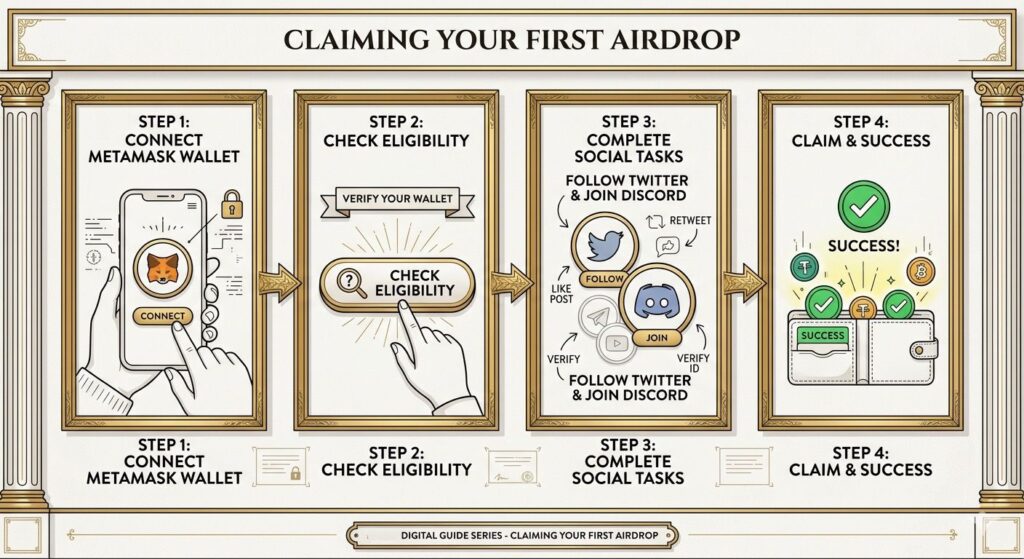
- Set up a compatible wallet — Most airdrops require a Web3 wallet like MetaMask. Make sure your wallet supports the blockchain the token is on (Ethereum, Solana, BNB Chain, etc.)
- Check eligibility — Some airdrops require you to have used a specific protocol. Connect your wallet to the airdrop checker to see if you qualify.
- Complete required tasks — If it’s task-based, finish what they ask — follow accounts, join communities, fill out forms.
- Submit your wallet address — Never share your private key or seed phrase. Only your public wallet address is needed.
- Wait for distribution — Tokens are usually sent in batches. It can take days or even weeks after the snapshot date.
- Check your wallet — Once distributed, tokens will appear in your wallet. You may need to manually add the token contract address to see them.
What Is a Snapshot?
You’ll hear this word a lot in airdrop discussions. A snapshot is when a project records all wallet addresses holding their token (or using their platform) at a specific point in time.
If your wallet meets the criteria at the moment of the snapshot, you qualify for the airdrop. If you buy tokens or use the platform after the snapshot, you miss it.
This is why following projects early matters — by the time an airdrop is announced publicly, the snapshot has often already happened.
Common Mistakes Beginners Make With Airdrops
I’ve made some of these myself — learn from them:
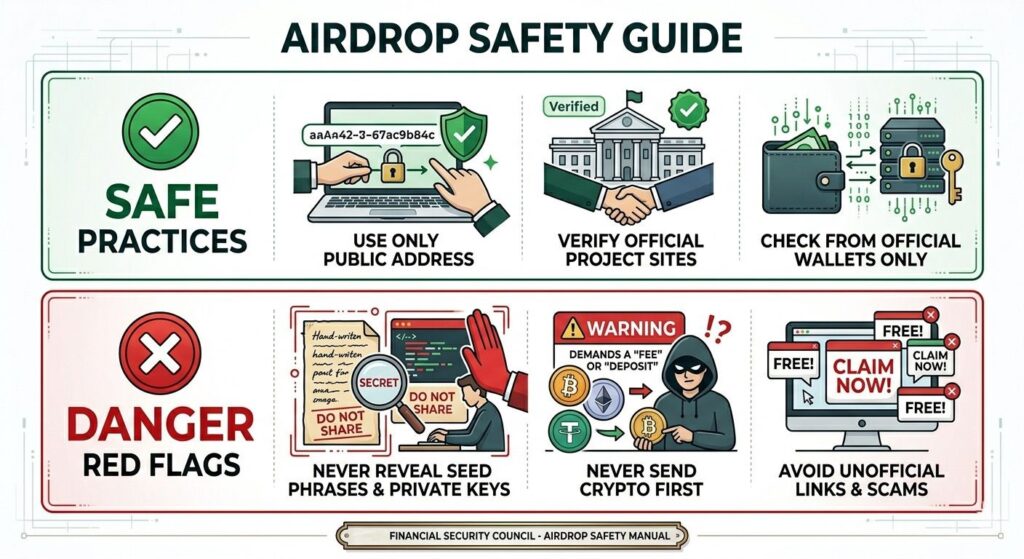
Sharing your seed phrase — This is the biggest one. No legitimate airdrop will ever ask for your wallet’s seed phrase or private key. If anyone asks, it’s a scam. Full stop.
Connecting your wallet to random websites — Scammers create fake airdrop websites that drain your wallet the moment you connect. Always verify a site is official before connecting.
Chasing every airdrop — There are hundreds of fake or worthless airdrops. Spending hours on tasks for tokens that are worth zero is a waste of time. Be selective.
Using your main wallet — For unknown airdrops, use a separate wallet with no real funds in it. This way even if something goes wrong, your main holdings are safe.
Ignoring taxes — In many countries, received airdrop tokens are considered taxable income at the time of receipt. Check your local tax laws — this catches a lot of people off guard.
How to Spot Airdrop Scams
The crypto space has a lot of scammers pretending to run airdrops. Here’s how to identify them:
- They ask for your private key or seed phrase — always a scam
- They ask you to send crypto first to receive more — always a scam
- The website has poor grammar, broken links, or looks rushed
- The project has no verifiable team, no whitepaper, no real community
- They DM you directly on Telegram or Twitter saying you’ve been selected — almost always a scam
- The token contract is not listed on CoinGecko or CoinMarketCap
If something feels off, trust that feeling. The crypto space rewards caution.
Are Airdrops Still Worth It in 2026?
Honestly? It depends.
The era of massive retroactive airdrops giving random users thousands of dollars has slowed down — but it hasn’t stopped. Protocols still reward early users. New chains still launch with token distributions. DeFi platforms still airdrop governance tokens.
The difference now is that most projects are more selective. They look for genuine users — people who actually interacted with the platform, provided liquidity, or contributed to the community — rather than people who just filled out a form.
So the strategy in 2026 is to use real protocols you actually believe in, interact with them genuinely, and let the airdrops come naturally. Trying to farm every airdrop with fifty wallets and zero genuine usage is getting harder to pull off and most projects have systems to filter it out.
The best airdrops come to real users. Be one.
You Might Also Like
- How to Buy Your First Crypto in 2026 — Beginner’s Complete Guide
- How to Use Binance Web3 Wallet on Desktop
Financial Disclaimer: This article is for educational purposes only and does not constitute financial advice. Cryptocurrency investments are highly volatile and carry significant risk. Always do your own research before investing. Never invest more than you can afford to lose.

and content creator with over 5 years of
hands-on experience in blockchain technology
and digital assets. He actively trades and
researches crypto markets daily, and shares
insights with over 110,000 followers on
Binance Square. He founded CrypBuzz.com to
provide honest, research-backed crypto
education for everyday investors.