I want you to stop for a second and really think about this.
Ten thousand Bitcoins. For two pizzas.
At today’s prices, that is over one billion dollars worth of cryptocurrency exchanged for what was probably a fairly average Papa John’s order. Two large pizzas. Some toppings. Maybe a side of garlic bread.
If you have been in crypto for any length of time, you have heard this story. But most people who know the punchline have never really sat with the full weight of what happened on May 22, 2010 — why it happened, what it meant in the moment, and why it continues to matter in ways that go far beyond the obvious “imagine if he held” narrative.
This is that story. Told properly.
Before Bitcoin Had Any Price At All
To understand what Laszlo Hanyecz did on May 22, 2010, you have to understand what Bitcoin was at that moment in time.
Bitcoin had been live for about sixteen months. Satoshi Nakamoto had published the whitepaper in October 2008 and launched the network in January 2009. The people who knew about it were a small, scattered group of cryptographers, cypherpunks, and curious technologists who communicated mostly on a niche internet forum called Bitcointalk.
There was no exchange. There was no price feed. There was no way to convert Bitcoin into dollars because nobody had agreed on what a Bitcoin was worth — or whether it was worth anything at all.
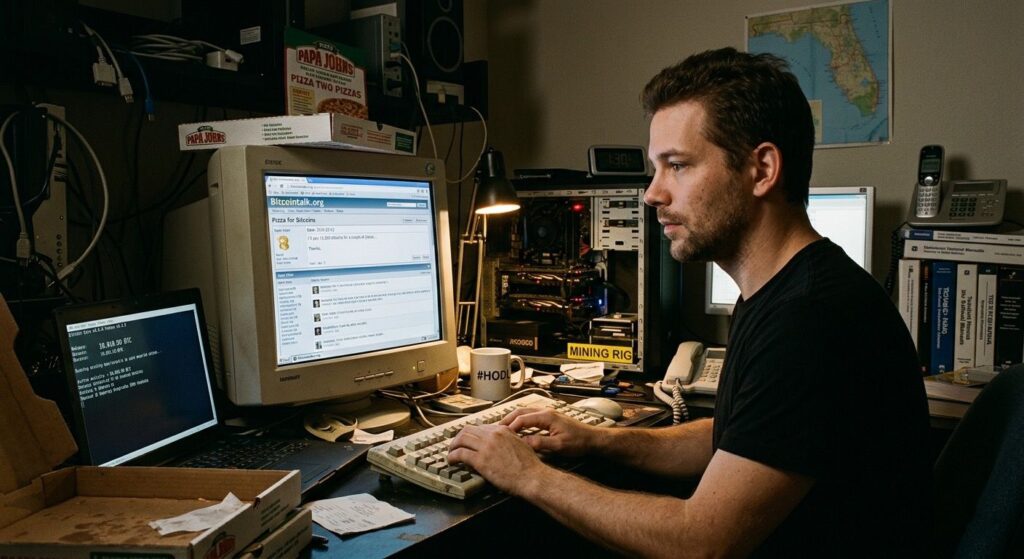
Miners were collecting Bitcoin for essentially nothing. The electricity cost was the only real expense. People sent Bitcoin back and forth to test the network, to prove it worked, to tinker with something they found intellectually fascinating. But using it to buy something in the real world? That had never happened.
Bitcoin existed in a kind of economic limbo. Brilliant technology. Zero established value.
Laszlo Hanyecz was a Florida-based software developer who had been mining Bitcoin since the early days. He had accumulated a significant amount — tens of thousands of coins — through his mining operation. And he had a problem that sounds almost philosophical when you frame it correctly.
He wanted to know if Bitcoin was real money.
Not in theory. Not in a whitepaper. In practice. Could you actually use it to buy something?
The Forum Post That Started Everything
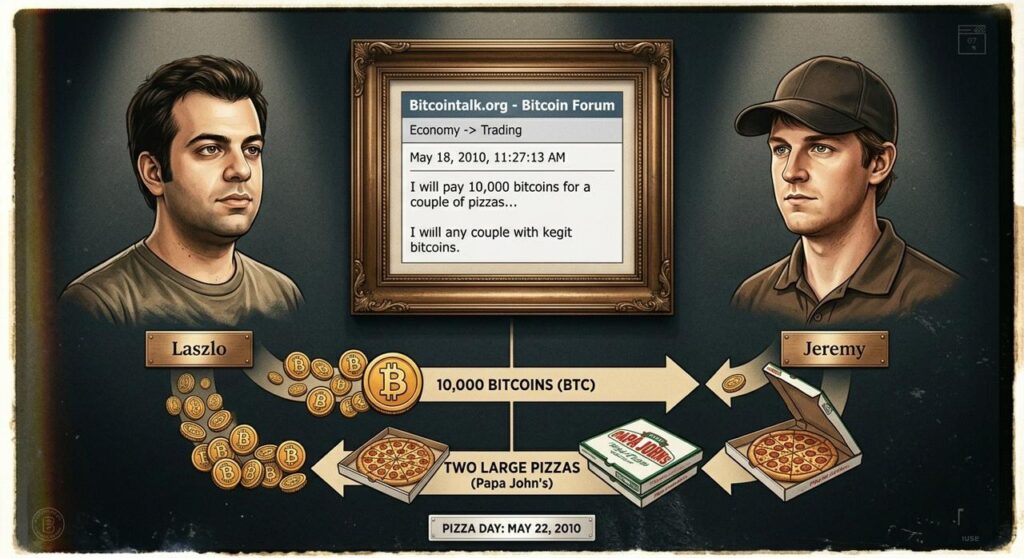
On May 18, 2010, Laszlo posted a message on the Bitcointalk forum. It has since become one of the most famous posts in internet history, though nobody knew that at the time.
He wrote that he would pay 10,000 Bitcoin to anyone who would order him two pizzas. He was not asking someone to accept Bitcoin directly — he was asking someone to order pizzas using their own money or credit card, deliver them to him, and receive 10,000 BTC in return.
The reaction from the forum was mixed. Some people thought the price was too high. Some thought it was too low. Most people were not sure how to value 10,000 Bitcoin because nobody really knew how to value any amount of Bitcoin.
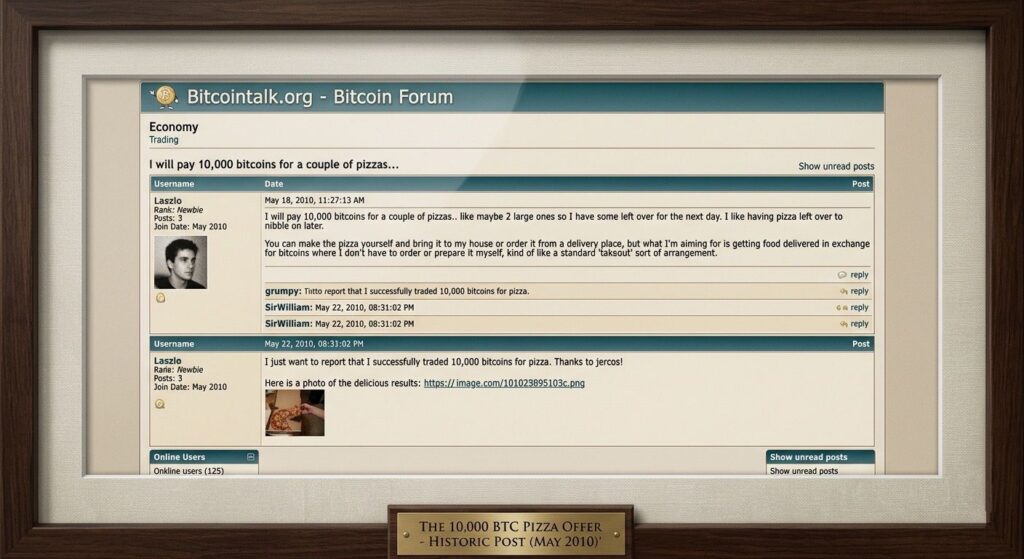
For four days, nothing happened.
Then a 19-year-old named Jeremy Sturdivant, who went by the username “jercos” on the forum, took Laszlo up on the offer. He ordered two large pizzas from Papa John’s — reportedly with toppings including jalapenos and onions — had them delivered to Laszlo’s address in Jacksonville, Florida, and received 10,000 BTC in return.
On May 22, 2010, Laszlo posted on the forum: “I just want to report that I successfully traded 10,000 bitcoins for pizza.”
He even attached photos of the pizzas.
What 10,000 Bitcoin Has Been Worth — A Timeline That Will Make Your Head Spin
This is the part of the story everyone focuses on, and for good reason. The numbers are genuinely staggering.
On May 22, 2010, 10,000 Bitcoin was worth approximately 41 US dollars based on the rough exchange calculations that existed at the time. About two cents per coin.
By the end of 2010, Bitcoin had risen to around 30 cents. Those pizzas would have cost roughly $3,000 in retrospect. Check Bitcoin Price Histroy.
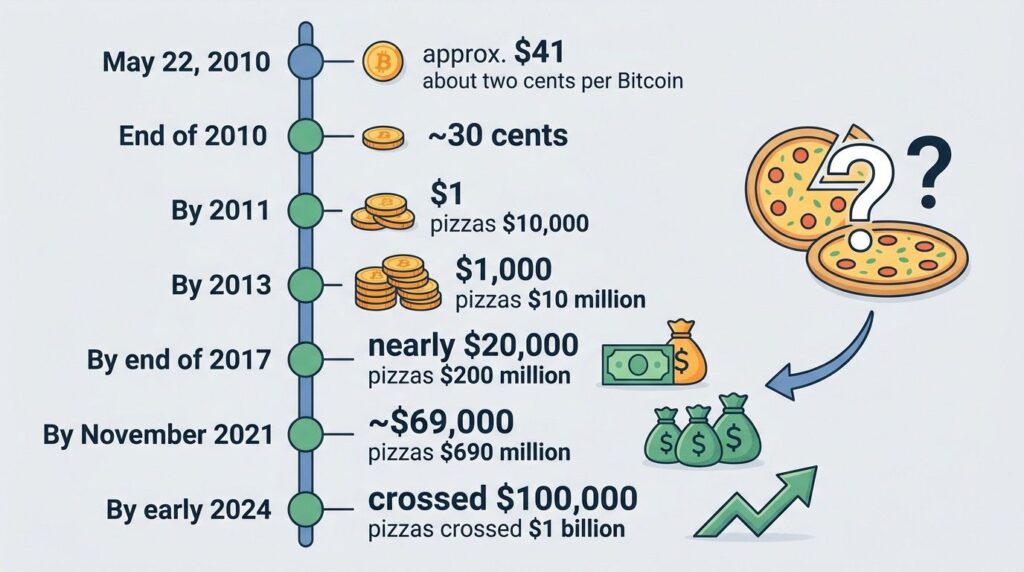
By 2011, Bitcoin briefly touched $1. The pizzas: $10,000.
By 2013, during the first major bull run, Bitcoin hit $1,000 for the first time. The pizzas: $10 million.
By the end of 2017, Bitcoin reached nearly $20,000. The pizzas: $200 million.
By November 2021, at Bitcoin’s peak of approximately $69,000: the pizzas were worth $690 million.
By early 2024, after the ETF approvals and institutional adoption surge, Bitcoin crossed $100,000. The pizzas crossed $1 billion.
Sitting with those numbers for a moment is worthwhile. Not to mock Laszlo — that misses the entire point — but to appreciate what they reveal about the trajectory of an asset that most of the world dismissed for years.
Was Laszlo Hanyecz Foolish?
This is the question everyone asks. And almost everyone gets the answer wrong.
The obvious take is that Laszlo made one of the worst financial decisions in human history. One billion dollars for pizza. It is an easy punchline. It has been repeated millions of times across social media, news articles, and crypto conversations for fifteen years.
But here is what that framing gets completely wrong.
Laszlo was not making an investment decision. He was making a philosophical one.
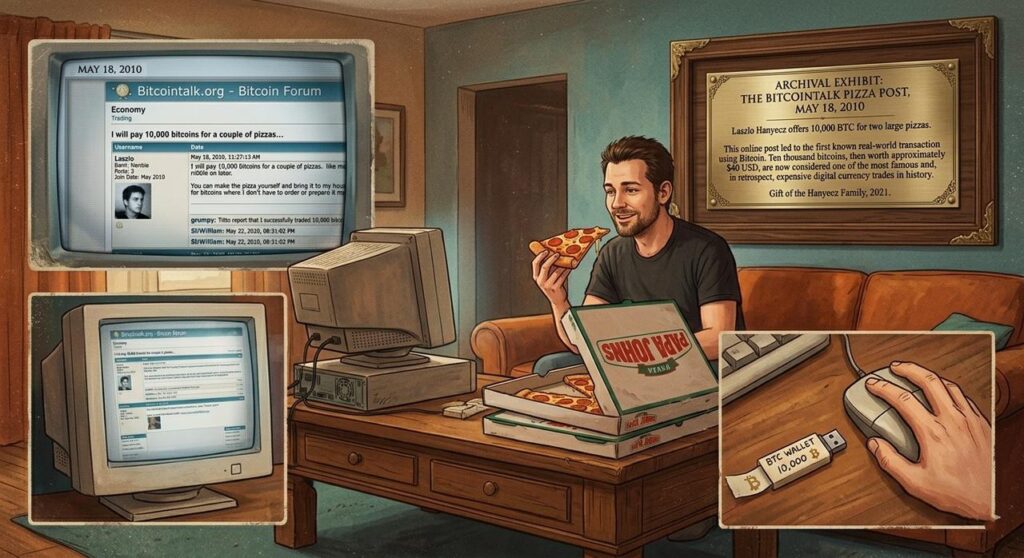
In 2010, Bitcoin had no value in any practical sense. It was numbers on computers, held by people who were not sure if it would ever mean anything. The question was not “should I hold this appreciating asset.” The question was “is this thing real money or not.”
By spending Bitcoin on something tangible — by completing an actual economic transaction — Laszlo answered that question. He created the first real-world proof that Bitcoin could function as a medium of exchange. He established, for the first time, that Bitcoin had a price in terms of real goods.
Every Bitcoin price that came after — every exchange listing, every institutional purchase, every ETF approval — traces its lineage back to that transaction. Before May 22, 2010, Bitcoin was an experiment. After May 22, 2010, it was a currency that had bought something.
Laszlo himself has said in interviews that he does not regret it. He understood what he was doing at the time — not in terms of future value, but in terms of what he was trying to prove. He wanted to participate in something new. He did.
The people who call him foolish are applying 2024 knowledge to a 2010 decision. That is not how decisions work. In the information available to him in May 2010, paying 10,000 Bitcoin for pizza was a reasonable experiment conducted by someone genuinely trying to advance a technology he believed in.
What Happened to Jeremy — The Person Who Ordered the Pizza
Laszlo gets most of the attention in this story, but Jeremy Sturdivant — the 19-year-old who actually placed the order — has a fascinating footnote of his own.
Jeremy received 10,000 Bitcoin for ordering two pizzas. He spent it. In an interview years later, he said he used it for travel and experiences during a period of his life when he needed the money. He expressed no regret either, noting that at the time it felt like a fair exchange.
This detail matters because it reinforces the same point about Laszlo. Nobody involved in this transaction was being careless or irrational. They were participating in an early economy where the rules had not been written yet and nobody had the information to know what they were holding.
The story of Bitcoin Pizza Day is not a story about two people who made mistakes. It is a story about two people who did something genuinely new — and paid the price that history assigns to pioneers, which is that the people who come after them get to benefit from the paths they cleared.
How Bitcoin Pizza Day Is Celebrated Now
May 22 has become an unofficial holiday in the crypto community. The way it gets marked has evolved significantly over the years.
Pizza restaurants in crypto-friendly cities run Bitcoin payment promotions. Companies in the crypto space offer discounts or free products to customers who pay in Bitcoin. Communities host meetups where pizza is ordered — sometimes actually paid for in Bitcoin, sometimes just symbolically.
The day gets significant coverage across crypto media every year. Twitter and other platforms fill with the familiar “imagine if he held” posts, alongside more thoughtful reflections on what the transaction actually meant.
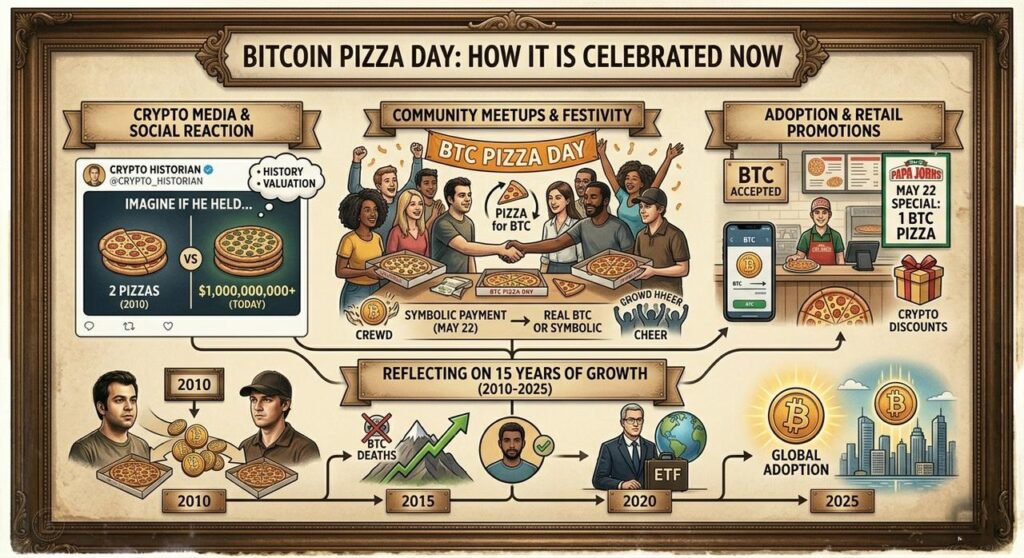
For people newer to crypto, Bitcoin Pizza Day serves as an accessible entry point into the history of the asset. It is a human story — two guys, a forum post, two pizzas — that makes the abstract history of digital money feel tangible and real.
For people who have been in crypto through multiple cycles, it is often a moment of genuine reflection. The distance between two pizzas and one billion dollars represents something more than a price chart. It represents fifteen years of a technology finding its place in the world, surviving multiple declared deaths, attracting the most sophisticated investors on earth, and arriving at a point that almost nobody predicted — including the people who believed in it most.
The Lesson That Actually Matters
I want to be careful here because I think the obvious lesson people draw from Bitcoin Pizza Day is not the most useful one.
The obvious lesson is: hold your Bitcoin. Do not spend it. Look what happens if you do.
That lesson, while numerically accurate in retrospect, misses something important.
If everyone who owned Bitcoin in 2010 had refused to spend it — if everyone had treated it purely as an investment to hold indefinitely — Bitcoin would never have developed the use case and legitimacy that made it valuable in the first place. Economic systems require transactions. Money that nobody spends is not money.
Laszlo’s pizza purchase was not a failure of financial discipline. It was an act of participation that helped create the market that later made Bitcoin valuable.
The actual lesson, the one that holds up across cycles and asset classes and technologies, is about conviction and information.
Laszlo had conviction in something new enough to actually use it — not just hold it, not just talk about it, but use it. That kind of conviction, combined with genuine understanding of what you are participating in, is what separates people who contribute to emerging technologies from people who observe them.
The question worth asking on every Bitcoin Pizza Day is not “what would those coins be worth if he held them.” The question is: what are you participating in today that you believe in enough to actually use?
Where Bitcoin Stands on Pizza Day 2026
Sixteen years after two pizzas changed history, Bitcoin is a fundamentally different asset in a fundamentally different world.
Spot Bitcoin ETFs approved in the United States hold tens of billions of dollars in assets under management. Central banks in several countries hold Bitcoin in their reserves. The Lightning Network processes millions of Bitcoin transactions daily, making small payments genuinely fast and cheap. Major retailers accept Bitcoin payments. Entire countries have made it legal tender.
The distance between a niche forum post asking if anyone wants to trade coins for pizza and this current reality is one of the most remarkable technological and financial journeys of the past century.
It did not happen because of any single decision or any single person. It happened incrementally, through the contributions of thousands of builders, advocates, investors, and yes — people who spent their Bitcoin when spending it felt like the right thing to do.
Laszlo Hanyecz did not lose a billion dollars on pizza. He spent 41 dollars worth of an experiment on something that proved the experiment was real.
Everything that came after started there.
This article is for educational and informational purposes only. Nothing here constitutes financial or investment advice. Cryptocurrency markets carry significant risk of loss. Always conduct your own research before making any investment decisions.
You might also like:-

and content creator with over 5 years of
hands-on experience in blockchain technology
and digital assets. He actively trades and
researches crypto markets daily, and shares
insights with over 110,000 followers on
Binance Square. He founded CrypBuzz.com to
provide honest, research-backed crypto
education for everyday investors.