I was watching my portfolio drop in real time when the notification came through.
Bitcoin had fallen from $123,000 to $113,000 in less than 48 hours. Ethereum was down over 9%. My feed was full of people calling it the end of the bull run, liquidation screenshots, and the usual flood of “I told you so” posts from people who had been predicting a crash for months.
And then Eric Trump posted two words on X.
“Buy the dip.”
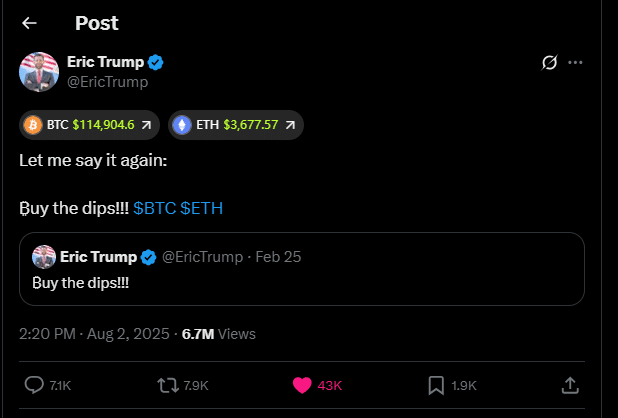
My first reaction, honestly, was to roll my eyes. It felt like exactly the kind of thing someone says when they want to sound confident about markets without actually explaining anything. But the more I sat with it — and the more I looked at the data behind what was happening — the more I thought there was something worth unpacking here.
This is my take on what happened that week, what Eric Trump’s tweet actually signalled, and how I think about dip-buying decisions when the market gets brutal.
What Actually Happened That Week
To understand why two words from Eric Trump caused such debate, you need to understand how bad the market felt at that moment.
Bitcoin dropped from $123,000 to $113,000. That sounds like a large number either way, but in percentage terms that is roughly a 8% drop in under two days. For a market that had been running hot, it felt like the floor had opened up.
The real damage though was in the futures markets. According to data from Coinglass, over $1.1 billion in long positions were liquidated in a 48-hour window. That means traders who had borrowed money to bet on Bitcoin going higher got wiped out automatically when prices fell. Liquidation cascades like this are brutal — each forced sell triggers more price drops, which triggers more liquidations, which triggers more selling.
Ethereum followed Bitcoin down, losing over 9% in hours.
At the same time, macro conditions were not helping. US tech stocks were selling off. Treasury yields were rising. The Federal Reserve had an upcoming decision hanging over markets that nobody felt certain about. It was the kind of week where even experienced investors start second-guessing everything.
That was the environment when Eric Trump posted.
The Tweet — And Why It Mattered More Than It Should Have
“Buy the dip.”
On its own, this is not a sophisticated piece of market analysis. It is a phrase that has existed in trading culture for decades. But context changes everything.
Eric Trump is not a random Twitter account. He is the son of the sitting US President, a family that had been increasingly vocal about their support for cryptocurrency. Earlier that same week, he had posted about digital assets representing what he called “a new frontier for monetary sovereignty” — language that signals genuine ideological alignment with the crypto space, not just casual interest.
The Trump family’s relationship with crypto had evolved significantly. What started with Donald Trump’s well-documented skepticism toward Bitcoin in his first term had shifted dramatically. By 2025 the family was actively involved in crypto ventures, NFT projects, and public advocacy for digital assets. Eric’s tweet landed in that context — not as a random opinion but as part of a pattern of increasingly visible support from people with real political influence over US regulatory direction.
That is why two words moved markets.
When someone with that kind of proximity to power signals confidence in crypto during a bloodbath, it sends a message to institutional money that the political wind is still blowing in crypto’s favour. And institutional money pays attention to that.
What “Buy The Dip” Actually Means — And When It Works
The phrase sounds simple. The strategy is not.
Buying the dip means purchasing an asset after its price has dropped, with the belief that the drop is temporary and the price will recover and eventually go higher. In theory, you are buying at a discount. In practice, the hard part is knowing whether the dip is a temporary correction or the beginning of a much longer decline.
The strategy works when three conditions are true.
The asset has genuine long-term value. Bitcoin has a 15-year track record of recovering from corrections that looked catastrophic in the moment. The 2020 crash took Bitcoin from around $10,000 to under $4,000 in days. Anyone who bought that dip and held made extraordinary returns. But that recovery was powered by real fundamentals — growing institutional adoption, halving supply dynamics, and increasing mainstream recognition. Buying a dip in an asset with no fundamentals is just catching a falling knife.
The broader trend is still intact. A dip within an uptrend is very different from a dip that marks the beginning of a bear market. In August 2025, Bitcoin was still well above its previous all-time highs, ETF flows were still net positive, and on-chain data showed long-term holders were not selling. Those are signs of a correction within a bull trend, not a trend reversal.
You can handle the volatility. This is the part people underestimate. Even if you buy a dip correctly and the asset eventually recovers, you might have to sit through another 20%, 30%, or 40% drop before it does. If you are using money you cannot afford to lose, or if the paper losses will cause you to panic sell at the worst moment, the strategy stops working no matter how good your analysis is.
Comparing This To Previous Bitcoin Corrections
One of the most useful things you can do during a scary market moment is zoom out and look at history.
The 2020 crash is the most cited comparison. Bitcoin dropped roughly 50% in March 2020 as COVID uncertainty sent every asset class lower. It looked catastrophic. Crypto communities were filled with people declaring the end of Bitcoin. In reality, it was one of the best buying opportunities in the asset’s history — within months Bitcoin had recovered fully and went on to hit $69,000 by late 2021.
The 2021 corrections followed a similar pattern. Bitcoin dropped from $64,000 to around $30,000 between April and July 2021. Again — panic, declarations that the bull run was over, massive liquidations. And again, the asset recovered and pushed higher.
The pattern is not a guarantee. Past performance does not predict future results in any market. But it does provide a framework for thinking about what a correction within a bull market typically looks like versus what a genuine trend change looks like.
In August 2025, the data available pointed toward correction rather than reversal. Bitcoin ETF inflows from major institutions like BlackRock and Fidelity had not reversed. The halving cycle, which has historically preceded the strongest bull market phases, was still playing out. Regulatory clarity in the US was improving rather than deteriorating.
Eric Trump’s tweet, whatever you think of the political context, was not wrong about the underlying direction.
How I Think About Dip Buying — Practical Notes
I want to be clear: nothing in this article is financial advice. I am sharing how I personally approach these situations, not telling anyone what to do with their money.
When I see a significant dip, the first thing I do is separate the emotion from the analysis. The market dropping feels terrible. That feeling is completely normal. But decisions made from fear almost always turn out to be worse than decisions made from analysis.
The question I ask is: has anything fundamental changed, or has only the price changed?
If Bitcoin drops 10% because of a liquidation cascade but ETF flows are still positive, long-term holders are still holding, and no major regulatory bad news has dropped — the fundamentals have not changed. Only the price has changed. That is a different situation than a 10% drop accompanied by a major exchange collapse, a regulatory crackdown, or evidence of systemic fraud.
I also think about position sizing more carefully during volatile periods. Rather than going all-in on a single price point, dollar-cost averaging — spreading purchases over days or weeks — removes the pressure of trying to time the exact bottom perfectly. Nobody consistently calls the exact bottom. DCA removes that requirement.
The Bigger Picture — What Political Support For Crypto Actually Means
There is a version of the Eric Trump story that is entirely about market dynamics — rich family member tweets, price moves, traders react. But I think the more interesting version is about what it represents structurally.
When people with significant political proximity are publicly and consistently bullish on crypto during market downturns, it signals something about the regulatory environment that matters for long-term holders.
The biggest historical risk to crypto was always regulatory — the possibility that governments would crack down hard enough to genuinely impair the technology’s ability to grow. That risk has not disappeared, but it has changed shape significantly in the US. The combination of Bitcoin ETF approvals, clearer legislative frameworks, and very visible political support has shifted the calculus.
That does not mean crypto is risk-free. It absolutely is not. But it does mean that one of the major downside scenarios that dominated bear market thinking for years has become less likely.
Final Thoughts
Two words from Eric Trump did not change the fundamentals of Bitcoin or Ethereum. What they did was provide a moment of clarity about where political sentiment sits during a moment of market fear.
The dip that week was real. The fear was real. The liquidations were real. But the underlying case for crypto — growing institutional adoption, regulatory progress, technological development — had not changed because of a price move.
Whether you bought that dip, held what you had, or stepped back from the market entirely during that week, the most important thing was making that decision based on your own situation, risk tolerance, and research — not based on panic, and not based on a tweet.
Even if the tweet made you stop and think. Which, if I am being honest, it did for me too.
This article is for informational and educational purposes only. Nothing written here constitutes financial or investment advice. Cryptocurrency markets are highly volatile. Always conduct your own research and consult a qualified financial advisor before making any investment decisions.